PAWSD’s Critical Challenges

Water Loss, Rate Inequity, and Leadership Gaps

Current State of Affairs

  • District 1 (Downtown): Pays minimal sewer rates ($3.20/month, according to a board member) The number isn’t published, but back of the envelope arithmetic indicats the number is around $17.
  • District 2 (Uptown): Treats sewage for both districts and individual ratepayers are charged $47/month for sewer treatment for both districts
  • Current Projects: $44M Snowball water treatment plant (incomplete), sewer plant upgrades ($12M estimated)
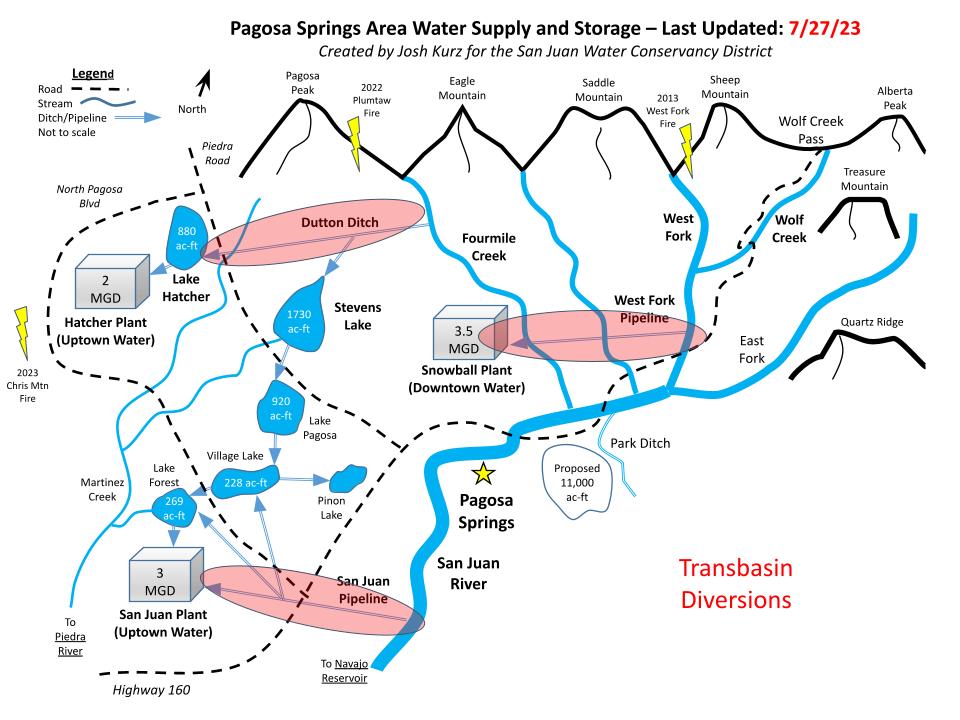
  • Water Sources: Water from Stevens can be moved to the main PAWSD water source, Hatcher Lake, but only by sending water downhill through the lake system and then pumping it uphill to Hatcher
  • Major Issue: 40% water loss through deteriorating distribution system
  • The Running Iron Ranch proposed reservoir site. PAWSD is suing the agency responsible for the reservoir, delaying revenue-generating proposals such as installing a solar-powered LPEA substation.

Pagosa Water Storage and Supply

A Divided Board Reverses Long-Standing Support


Affordable Housing Project Torpedoed

Updated 2026-01-27 By a narrow 3-2 vote, the Pagosa Area Water and Sanitation District (PAWSD) board on 2025-09-11 rejected a request to waive water and sewer fees for the Pagosa Springs Community Development Corporation (CDC), jeopardizing a multi-agency effort to build affordable workforce housing in Archuleta County.

Without this waiver, the project cannot move forward. “Waiving the capital investment fees is not just about cost savings,” said Emily Lashbrooke, CDC Director. “It is essential to:

PAWSD’s Vital Role in Affordable Housing Initiatives

Funding Continuation to be Discussed at a Special Meeting on Monday

The monthly affordable housing surcharge is a hot-button issue for conservatives who don’t like the idea of subsidizing housing for police, firefighters, teachers, service workers, and others.

Archuleta County is an expensive place to live with the average home price of $580,000 and monthly rents at $2,168 (per Zillow). Even with help from the county, private donations, non-profits, and PAWSD, the units built by Habitat for Humanity still cost more than $300,000.
Your Cash Down the Drain

Grab your wallet and eyeball the Lake Hatcher water level. Drought surcharges for residents (not businesses) are coming to your water bill.

The Pagosa Area Water and Sanitation District sent out a confusing news release Tuesday describing the PAWSD Board of Directors’ declaration of a Stage 2 Drought. Why grab your wallet? By declaring a Level 2 Drought, your water charges will double for use of more than 8,000 gallons a month.

🚰 Running Iron Ranch Sale: Unanswered Questions About Our Community’s Future

The proposed sale of the Running Iron Ranch — a key property tied to the San Juan Headwaters Project and our region’s long-term water security — raises urgent questions that deserve thoughtful public dialogue and full transparency.

💧 Why the Running Iron Ranch Matters

For nearly two decades, the Dry Gulch site — including the Running Iron Ranch — has been identified as a vital location for a potential future reservoir. The Pagosa Area Water and Sanitation District (PAWSD) and San Juan Water Conservancy District (SJWCD) have invested millions into this vision, with PAWSD continuing to make significant loan payments tied to the property.

The Role of Communication in Transparent Governance

Did you know that PAWSD has a budget of $56 million? That’s more than the budgets of the town, county, and school board.

Do you know how that sewer charge on your bill is calculated? Do you know where that money is going?

The Snowball water treatment plant is being rebuilt at a cost of $44 million. Most of the cost is paid for by ratepayers. The plant will serve downtown and points east and south.

Why Ratepayer Voices Matter in Water Decisions

It’s Your Money: Rate Hikes Have Just Started

The reason PAWSD currently has a healthy debt service coverage ratio is because
PAWSD has completed a series of substantial increases in its service fees and other
charges in recent years, and additional substantial increases will be required to maintain these debt service coverage ratios in the future. PAWSD currently projects the following cumulative increases between 2019 and 2032:

a. “Water Service Rates: 57%
b. Water Capital Investment Fees: 230%
c. Wastewater Service Rates: 112.5%
d. Wastewater Capital Investment Fees: 1,270%.”

How to Collaborate with PAWSD Effectively

By Carl Young

Communication with PAWSD can be difficult. Unlike the San Juan Water Conservancy (SJWC), Town of Pagosa Springs and the Archuleta County Board of County Commissioners, ratepayers have no public way to directly contact PAWSD Board members. All communication runs through PAWSD staff.

Unfortunately, this follows the PAWSD pattern of providing the minimum legal compliance for public communication.

I would encourage concerned ratepayers to ask the PAWSD Board to follow the examples of SJWC, the town and county and give ratepayers a way to directly contact board members.

Community Engagement: A Key to Better Water Management

Personally, I don’t understand the emotion around “The Reservoir.” Ask an opponent and you will trigger a red-faced, angry response. The emotional outburst overwhelms any argument otherwise.

For me, the angry outbursts over the reservoir remind me of the controversy over our participation with La Plata County in a joint health department. Because of the anger of some Archuleta County residents, we now have our own health department.

The Million-Dollar Typo: Why PAWSD Must Correct the March 14 Record

By Carl Young, pausepawsd.com

2026-01-27

The Promise: A Specific Restriction (and a Missing Document) On March 14, 2024, Emily Lashbrook of the CDC appeared before the PAWSD Board to request a full waiver of Capital Investment Fees (CIF) for eight workforce housing projects.

At stake: a carefully crafted agreement to build more affordable housing in Pagosa Springs. Funders include the Department of Local Affairs, Archuleta County, and the Town of Pagosa Springs. The CDC request was for $260,000 from the PAWSD Board. (See A Divided Board Reverses Long-Standing Support)